In late September 2019, one of the most iconic moments in PlayerUnknown’s Battlegrounds history unfolded not with a stunning snipe, but with a look of sheer bewilderment. Michael “shroud” Grzesiek, the former CS:GO professional turned streaming superstar, returned to PUBG after a hiatus in World of Warcraft Classic only to encounter a game-breaking audio bug that left him helpless inside a building on Erangel. The incident, which saw shroud struggling to locate an enemy solely through footsteps, would become a rallying cry for a community desperate for reliable spatial audio. Seven years later, the echoes of that moment still resonate, yet they tell a radically different story of technological advancement and player-focused development.
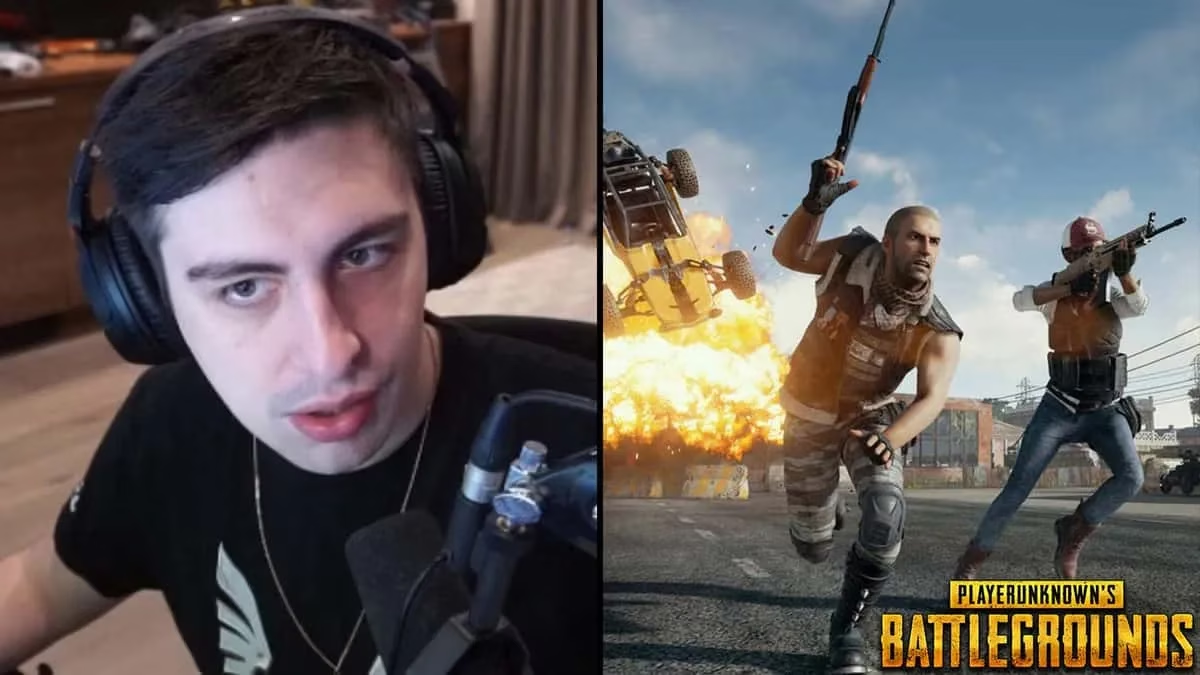
The situation was as simple as it was maddening. Following the 4.3 Update, shroud found himself trapped in a house with an opposing player. Footsteps clattered through his headset, but the directional cues were so distorted that he could not discern whether the threat was approaching from the stairs, the roof, or the room behind him. "I don't know. I'm hearing audio, and I don't know," the Canadian streamer stammered, his legendary aim useless without the basic spatial awareness that competitive shooters rely on. "I couldn't decipher anything that was happening right there. Holy shit. That's not just me, that's the game, right? Holy moly." The frustration culminated in a death from an angle he never expected, followed by an immediate switch to the RPG title Dauntless. Clips of the moment went viral, crystallizing a persistent pain point: PUBG’s audio engine was failing at the most fundamental level of a battle royale experience.
The Immediate Aftermath and Developer Response
The good news was that PUBG Corporation did not ignore the outcry. Within days, Community Manager Hawkinz acknowledged the severity of the issue on official forums, confirming that the development team was “working hard” to resolve the audio inconsistencies and that an internal fix was already under testing. This responsiveness, however, was only the first step in a much longer journey. The core problem was deeply rooted in the game’s early audio architecture, which struggled to handle complex verticality and dynamic occlusion. Simple fixes could patch the most egregious bugs, but a true transformation would require a comprehensive redesign.
A New Acoustic Blueprint: HRTF and Beyond
Over the following years, PUBG underwent a series of audio overhauls that fundamentally changed how sound behaves on the Battlegrounds. The introduction of Head-Related Transfer Function (HRTF) processing was a milestone, allowing headphones to simulate the way human ears perceive direction, elevation, and distance with far greater nuance. Vertical audio, once the bane of players trapped in multi-story compounds, became crisp and intuitive. By 2024, the implementation of a dynamic reverb system meant that gunshots in a concrete warehouse sounded entirely distinct from those echoing across the open fields of Miramar. Footsteps on metal, wood, and grass each carried unique acoustic signatures, providing skilled listeners with a wealth of information.
In early 2025, PUBG Studios (the rebranded development team) took another leap forward with the “Echolight” engine update. This system integrated real-time ray-tracing for sound propagation, calculating audio paths that bounce off surfaces and subtly change based on the environment’s geometry. A player sprinting behind a rock now produces a muffled sound shadow, while a sniper shot from a hilltop generates a realistic crack-and-slap delay. The technology effectively closed the gap between what players see and what they hear, eliminating the cognitive dissonance that had plagued shroud years earlier.
The Player Experience in 2026
Today, in 2026, the audio landscape of PUBG stands as a benchmark for battle royales. Newcomers stepping into Taego or Deston for the first time are greeted by a soundscape so immersive that instinctual positioning is almost immediate. The community’s once-constant complaints about “broken audio” have faded into meme-filled nostalgia. Professional leagues now use the game’s advanced audio as a competitive tool, with casters occasionally analyzing 3D sound visualizations during replays to highlight a player’s pinpoint hearing.
Gone are the days when a veteran like shroud would abandon a match in confusion. His 2019 outburst, however, remains a pivotal chapter in the game’s history—a stark reminder that even the most polished mechanics can crumble without trustworthy sensory feedback. Thanks to years of relentless refinement, the terror of being unable to tell where an enemy is coming from has been replaced by the far more enjoyable terror of knowing exactly how close and in what direction they are. PUBG’s audio journey from dysfunction to excellence is a testament to a development philosophy that turns player pain points into pillars of innovation.
The Legacy of a Bug
The audio issues that surfaced in Update 4.3 were never just about a single streamer’s bad night. They exposed a critical vulnerability in a game that prided itself on realism and tactical tension. By 2026, PUBG has not only repaired that vulnerability but transformed it into one of its strongest assets. The story is a lesson for the industry: when the community screams about broken audio, the best answer is not just a hotfix, but a long-term commitment to re-engineer the experience from the ground up. And as for shroud? He’s been spotted back on the Battlegrounds this year, meticulously sound-whoring his way to Chicken Dinners with a confident smirk that says, finally, “I know exactly where that was.”
Comments