Seven years ago, I was just another player grinding Chicken Dinners in PlayerUnknown’s Battlegrounds when PUBG Corporation dropped a bombshell that would reshape competitive gaming. As we sit here in 2026, I can confidently say those announcements didn’t just make headlines—they laid the foundation for a thriving, sustainable esports ecosystem. But what exactly did they roll out back in 2019, and how did it all play out over the years? Let me take you through the game-changing initiatives that every PUBG fan should remember.
💰 Profit Sharing That Put Players First
The most revolutionary move was the introduction of revenue-sharing on digital items. For the first time, teams participating in the North American National PUBG League (NPL) and the PUBG Europe League (PEL) would receive a direct cut of in-game sales. Starting from Phase 2 of each league, PUBG Corp. created exclusive NPL and PEL-branded items, with 25% of all sales funneled straight to the teams in those leagues. As a fan, buying a hoodie or weapon skin suddenly felt like directly supporting my favorite roster. It was a powerful feeling—and it turned casual viewers into invested stakeholders.
But they didn’t stop there. For third-party tournaments organised by the likes of ESL, PUBG Corp. also crafted exclusive global event items. Once again, 25% of those sales went to the participating teams. On top of that, the developer matched the prize pool of each partnering tournament provider, effectively doubling the pot. Imagine grinding through qualifiers, knowing that every viewer purchase actually sweetened the victory you were chasing. That’s a motivation no flat prize pool could ever match.
Come the PUBG Global Championship, another digital item was born, and 25% of its sales flowed straight into the championship prize pool. Teams that qualified for that pinnacle event also received their own exclusive team-branded items, while the eventual champion got a special celebratory item. The revenue split remained consistent: 25% from team-branded items to each respective team, and 25% from the champion’s item divided among the winners and all teams from their league. How many esports can say every skin you buy actually rewards the players you cheer for? Not many.
🚌 Operational Support That Lowered the Barrier
It’s one thing to dangle prize money; it’s another to help teams survive day-to-day. PUBG Corp. stepped in to offset operational costs for teams competing in NPL and PEL. Travel expenses? Covered. Housing subsidies? Checked. Local transportation fees? Taken care of. This wasn’t just a goodwill gesture—it was a deliberate strategy to lower the barrier to entry. No longer did aspiring pros need to survive on ramen while chasing a dream. The publisher was essentially saying, “We’ve got your back.”
Richard Kwon, then-CMO at PUBG Corp., famously said: “We are nothing without our teams and players, so it’s critical that we develop these programs to support our competitive scene and help teams build their brands. In addition to building a popular esport that caters to our PUBG fanbase for years to come, we want to create a financially viable environment for players to sustain themselves and profit from their hard work.” Looking at the packed arenas and robust tier-two scene in 2026, I’d say that vision materialised.
🎮 FaceIT Showdown: The Grassroots Heartbeat
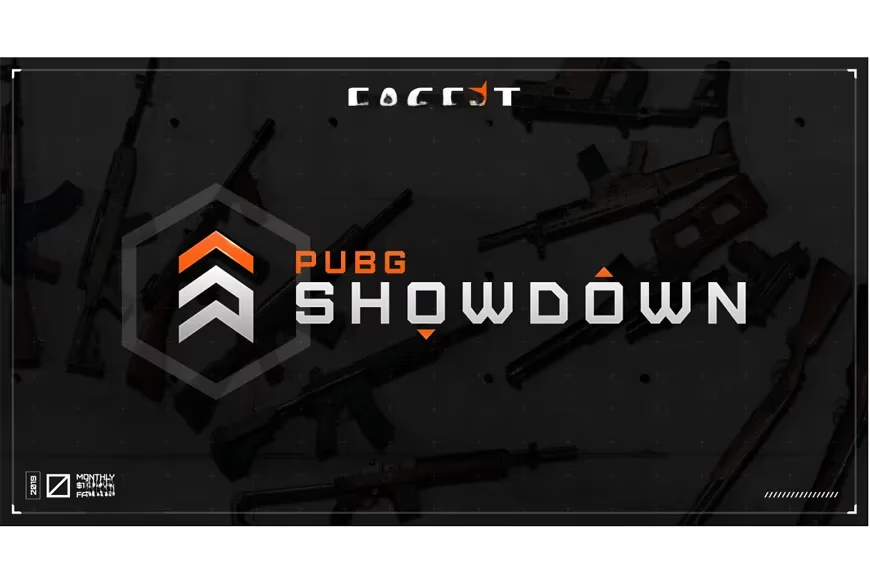
While the publisher was busy crafting its pro league framework, UK-based platform FaceIT was igniting the grassroots with the FaceIT PUBG Showdown. This series of weekly Duo qualifiers gave everyday players a shot at glory—and a cool $10,000 prize pool per final. No subscription was required; just link your FaceIT account to PUBG and sign up. I remember queuing into those qualifiers myself, fingers trembling as 150 teams fought across three maps over two brutal rounds.
Each month, the six qualifier winners plus the best-performing teams advanced to a live online final, broadcast from FaceIT’s London studios by a “familiar cast of A-list talent.” The production value was insane for a community tournament. And here’s what made it special: every final was streamed on the FaceIT Twitch channel, turning unknown players into household names overnight. The first qualifier kicked off on a Thursday back in January 2019, and the series ran successfully for several seasons, becoming a blueprint for community-driven competition.
🔄 Did It All Work? A 2026 Perspective
Now that we’re in 2026, it’s easy to take profit-sharing and org-friendly policies for granted. But rewind to 2019, and you’ll see that PUBG Corp. was taking a massive risk. Esports was still a wild west where teams burned cash and players retired at 22. By weaving digital commerce into competitive integrity, they created a self-reinforcing loop: viewers buy items → teams earn revenue → better practice facilities → higher skill ceiling → more viewers. Has it been perfect? Of course not—some smaller regions still struggle, and the split for third-party events sometimes favours larger organisers. But the structural shift is undeniable.
🔹 What can other esports learn from this?
-
Direct revenue sharing turns fans into patrons.
-
Operational subsidies keep talent pipelines alive.
-
Grassroots tournaments like FaceIT Showdown feed the top with hungry, undiscovered stars.
I recently spoke to a young player who was only 12 when these changes were announced. He told me, “I saw PUBG Corp. actually caring about pro players, and that’s when I knew I could pursue this without my parents going broke.” That’s the lasting legacy of those 2019 moves.
So whether you’re still dropping Pochinki in 2026 or just discovering the competitive scene, know this: the foundations you enjoy today were laid by a developer and a community platform that dared to put their money where their esports was. And for me, as a player who watched it all unfold, it’s been one hell of a ride. 🐔🏆
Comments