Yo, what's up everyone! As a long-time FPS fanatic, I've been absolutely glued to the wild evolution of the genre. And let me tell you, the ripple effects of PlayerUnknown's Battlegrounds (PUBG) are still being felt in 2026, especially when we look at giants like Battlefield. 🎮 Remember back in the late 2010s? PUBG dropped and basically rewired everyone's brains on what a shooter could be. It wasn't just another corridor shooter; it was a massive, tense, last-man-standing sandbox. That seismic shift didn't just affect us players—it sent shockwaves through the entire industry, right up to the boardrooms of companies like EA.
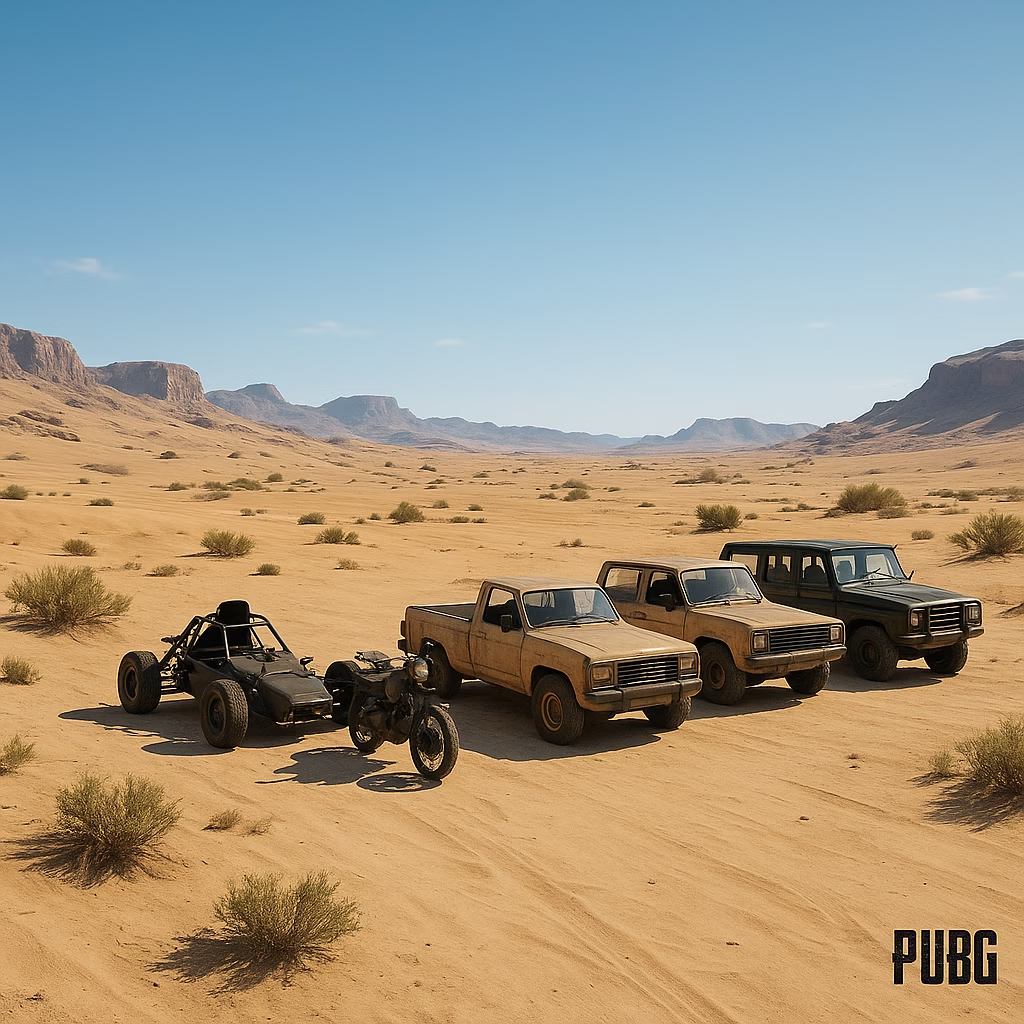
EA's CEO, Andrew Wilson, actually broke this down perfectly. He talked about how esports and massive viewer engagement are key to pulling in new crowds—people who might not even own a controller yet. "We always believe, at its very core, esports is going to drive tremendous engagement in our community and allow us to reach broader communities of viewers who maybe have never played our games before," Wilson said. This philosophy isn't just about selling more copies; it's about building a living, breathing universe around a game. And when a phenomenon like PUBG explodes, it becomes a masterclass in this very idea. It showed that a game could dominate Twitch streams and in turn, dominate sales charts.
But here's the real juicy part for us Battlefield devotees. Wilson pointed directly to PUBG's success as a wake-up call for innovation. "I think what you discover in this industry is there's a lot of great vectors that drive player engagement. And one of those is just innovation in the core gameplay mechanic," he explained. "And what the team, with PUBG, have done is really deliver a new level of innovation that changed the way people were playing first-person shooter games." 🔥 Think about it: before PUBG, the big military shooters were largely about scripted moments and linear conquest. PUBG threw that out the window for emergent, player-driven stories. Every match was unpredictable. That's the kind of magic EA wanted to capture.
Now, before you panic, Wilson was crystal clear: this didn't mean EA was just gonna slap a battle royale mode into Battlefield and call it a day (though, looking at you, Firestorm 👀). "And that doesn't mean just kind of PUBG replicas inside of the Battlefield universe," he assured everyone. "But it does mean that our Battlefield teams...are looking at how they innovate in every aspect of the game, including core gameplay and map design." This was a mandate to think bigger. The pressure was on for DICE to not just iterate, but to reinvent—to find those "new and innovative ways to play" that could capture the same lightning in a bottle.
Let's be real, the business incentive was MASSIVE. PUBG was breaking records left and right. It debuted on Xbox and instantly grabbed over 4 million players. For EA, which had just seen Star Wars Battlefront II stumble hard on sales expectations, those numbers were like a siren's call. They proved there was a hungry, massive audience for a new kind of large-scale, tactical shooter experience.
So, what did this mean for the future? Looking back from 2026, we can see the legacy. That push for innovation Wilson talked about directly influenced the design philosophy of later Battlefield titles. We started seeing:
-
Massive, interactive maps that felt more like living playgrounds than set pieces.
-
A greater emphasis on emergent gameplay and player agency.
-
Experiments with persistent elements and deeper progression systems to keep players hooked for the long haul.
It wasn't about copying the battle royale formula verbatim. It was about absorbing the core lessons: scale, tension, unpredictability, and community-driven content. The goal was to make every round of Battlefield feel as uniquely memorable as a chicken dinner run in PUBG.
In the end, PUBG's impact was a classic case of healthy competition driving the industry forward. It forced everyone, even the established kings like Battlefield, to look in the mirror and ask, "How can we be better? How can we surprise our players again?" As a player, that's all we can really ask for. The conversation started by Wilson years ago set the stage for the incredible, varied shooter landscape we enjoy today. It reminded developers that the most powerful weapon in any game isn't a gun—it's a fresh idea. And that's a win for all of us. 💪 What do you guys think? Did PUBG's influence make Battlefield better, or did it push the series in a direction you didn't love? Let me know in the comments!
Comments