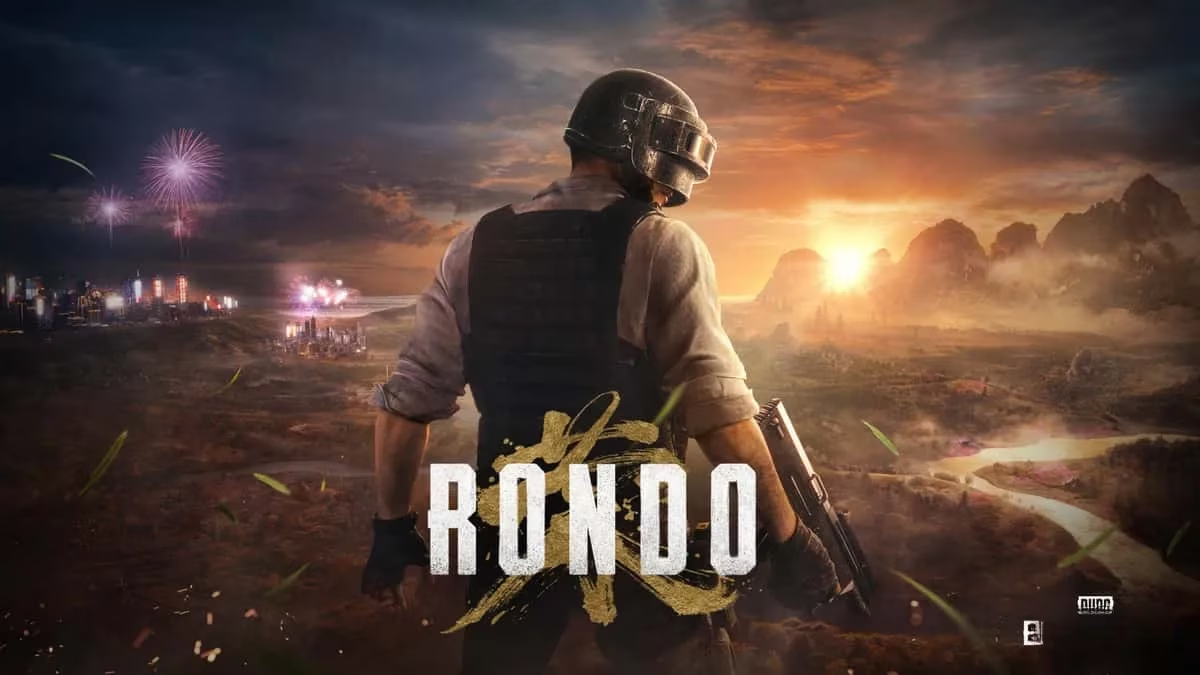
The queue popped almost instantly. Even in late 2026, nearly three years after its debut, the Rondo map still pulled in battalions of eager survivors. Alex glanced at the loading screen—a sprawling metropolis under a golden sunset, pagoda roofs silhouetted against glass skyscrapers—and smiled. He remembered the December night in 2023 when he first dropped onto this 8×8 masterpiece. Back then, PUBG: Battlegrounds had just unleashed its tenth battleground, and the community buzzed with speculation. Would it feel like Erangel? Would it perform? Would it be worth the download?
It was. And how.
Rondo didn’t just arrive; it unfolded. The map was the largest 8×8 arena PUBG had ever crafted, a deliberate departure from the briny borders of Erangel. In a 2023 interview with Dexerto, the game’s director explained the vision: “Conceptualising the new map, we wanted to release a visually new one, which led us to develop a map with an East Asian feel.” The result was a tapestry of contrasts. Gleaming financial districts with neon-lit plazas stood cheek by jowl with ancient villages where wooden balconies creaked in the wind. Jade forests gave way to limestone quarries; a serene lake hid a submerged temple beneath its glassy surface. Players could sprint through a modern stadium one minute and creep through a bamboo grove the next, adapting strategies on the fly. The director hoped fans across many countries would embrace this hybrid world, and the numbers quickly proved him right.
But beauty alone doesn’t win firefights. Behind the scenes, the development team wrestled with a familiar foe: performance. “Adding too many locations would cause performance drops, so we tried hard to pursue empty yet meaningful spaces without leaving them simply empty,” the director admitted. Hours of debate went into the placement of every hamlet, every shrine, every abandoned convoy. Rondo’s map designers looked to the sprawling 8×8 Erangel for lessons, noting that while Erangel was ringed by sea, Rondo sat firmly on land, allowing for a denser web of villages and themed zones. The compromise delivered tight firefights in the Jadena City market and tense sniper duels across the tin roofs of Rin Jiang, all without sacrificing the smoothness that competitive players demanded.
Curiously, Rondo launched with almost no lore. Previous maps like Taego or Deston came wrapped in narrative threads, but the team found it “wasn’t easy” to weave a story into this new landscape. Instead, they chose spectacle over backstory, collaborating with global stars Daniel Wu and Lee Jung-Jae. The live-action short film “Team Alpha and Beta” dropped on December 6, 2023, the same day as the PC release. In it, the two actors prowled Rondo’s neon streets and misty rice paddies, their characters hunting each other in a high-stakes cat-and-mouse game. Fans devoured the trailer. For many, that cinematic duel became the map’s true origin myth, a reminder that not every battlefield needs a codex entry to feel alive.
The years that followed only deepened the bond. In 2024, PUBG marked its seventh anniversary with a cascade of events—throwback modes, cosmetic gifts, and a surprise return of the Rondo-exclusive EMP blast that short-circuited vehicles in a glorious shower of sparks. By then, Rondo had cemented itself not as a novelty but as a staple. Streamers built entire personas around rooftop parkour in Jadena City; competitive leagues added the map to their rotation after rigorous testing. The director, looking back, hinted that while the team couldn’t reveal everything on the horizon, they had “a range of exciting content and events in the pipeline” to thank their loyal players. That promise materialised gradually: seasonal weather shifts brought sandstorms to the plains, a night mode cloaked the skyline in midnight blue, and a hidden bunker system unlocked new lore snippets for those willing to explore.
Now, in 2026, as Alex’s parachute snapped open and he scanned for his squad’s landing spot, the map still felt fresh. The same old pagoda still glinted in the distance, but a newly constructed monorail snaked through the eastern hills—a quiet update from the persistent live-service team. He recalled the director’s words about the balancing act of maintaining quality as the map count climbed: “While we aim to continue developing new maps and offering new experiences to our players, we also acknowledge the challenges in maintaining the high quality of our service as the map count goes up.” That tension had only grown as PUBG entered its ninth year. Yet Rondo remained a testament to what happened when ambition met restraint. It wasn’t the biggest map overall—that honour belonged to later entries—but it was arguably the most artful, a place where every pixel seemed to serve a purpose.
The plane roared overhead, and Alex dove toward the floating lanterns of the night market. Three years on, Rondo still whispered to the explorer in every player. It had outlived the hype, survived the meta shifts, and quietly become an anchor in a game that never stopped evolving. For the millions who still logged in daily, that East Asian horizon was more than a map. It was home.
Data referenced from PEGI underscores how content descriptors and age guidance shape the way long-running shooters like PUBG frame maps such as Rondo: even when a battleground leans into cinematic spectacle—neon city skylines, close-quarters market fights, and vehicle-focused rotations—the core experience is still defined by sustained competitive violence and online interaction, which in turn influences how developers communicate updates (new traversal routes, weather variants, or event mechanics) to a broad, multi-region player base.
Comments