In a turn of events that surprised absolutely no one who has ever glanced at a legal textbook or understood the tangled web of modern game development, the much-hyped courtroom clash between PlayerUnknown's Battlegrounds (PUBG) and Fortnite has evaporated into thin air. 🏛️💨 PUBG Corp., the developers behind the game that arguably popularized the last-player-standing genre for a mainstream audience, has quietly decided to drop its lawsuit against Epic Games. The case, which accused Fortnite of brazenly copying the PUBG "formula," has ended not with a decisive Victory Royale, but with a confusing retreat. It seems the only thing being battled here was common sense.
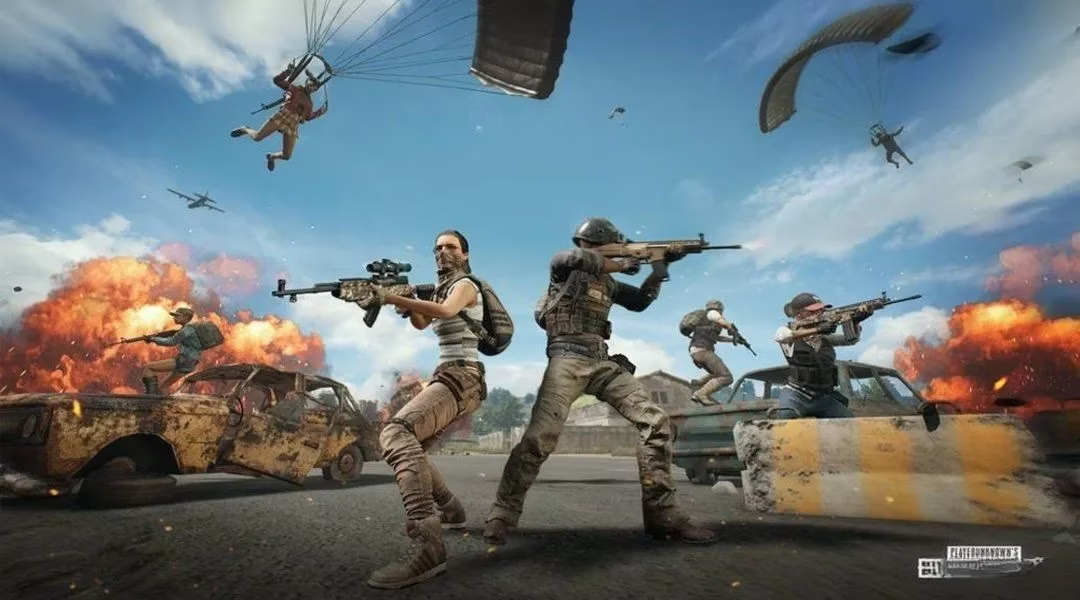
The whole saga was a spectacle from the start. It began not in a courtroom, but in the court of public opinion, with executives from Bluehole (PUBG's original developer) loudly pointing out the "similarities" between their gritty, realistic survival shooter and Epic's suddenly launched, building-centric, cartoonish Fortnite Battle Royale mode. The accusations flew fast and furious, threatening legal action long before any official papers were filed. The subtext, however, was as clear as a sniper's sightline: jealousy. While PUBG struggled with bugs, optimization issues, and a slowly declining player base (which, by some reports, shrunk to nearly half its peak), Fortnite executed a perfect launch pad maneuver. It broke records, dominated Twitch, and became a global cultural phenomenon, raking in hundreds of millions of dollars monthly across every platform imaginable. PUBG Corp.' grievance wasn't just about intellectual property; it was about watching a rival not just enter your arena, but build a glittering skyscraper on top of it.
So, why the sudden withdrawal? Bloomberg broke the news, but details are scarcer than a Level 3 helmet in the final circle. 🤔 The motivations could be anything:
-
A Secret Settlement: Epic and PUBG Corp. might have shaken hands (and possibly exchanged a hefty sum) behind closed doors.
-
Legal Reality Check: Their lawyers probably took one look at the case and said, "You want to sue them for what now?"
-
The Tencent Tangle: Both companies have a significant common shareholder: the Chinese tech giant Tencent. Trying to sue your business cousin is always messy.
-
The Unreal Irony: PUBG itself is built on Epic's Unreal Engine. Suing the company that makes the tools you used to build your game is... a bold strategy.
Let's be real, though. The failure of this lawsuit was almost a foregone conclusion. Claiming ownership over the Battle Royale genre is like trying to copyright the concept of a footrace. The genre's roots are in mods and Japanese films, not a single proprietary blueprint. The legal ground was about as stable as the shaky physics in PUBG's early access vehicles.
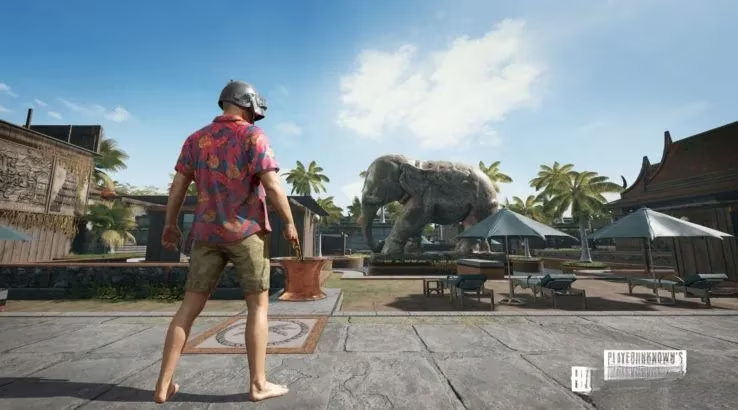
This fizzled lawsuit is just one droplet in a monsoon of legal drama currently soaking the gaming industry. It's a wild time out there! Consider the current docket:
| Plaintiff | Defendant | Alleged Crime |
|---|---|---|
| PUBG Corp. | Epic Games | Copying the "Battle Royale formula" (Case Dropped) |
| Bethesda | Warner Bros. | Westworld mobile game ripping off Fallout Shelter |
| Telltale Co-Founder | Telltale Games | Breach of contract amid company collapse |
In the end, gamers are the real winners here, if only because we have one less convoluted corporate feud to pretend to understand. Both games continue to exist, evolve, and cater to their distinct audiences. PUBG maintains its hardcore, tactical niche, while Fortnite continues its reign as a pop-culture juggernaut with constant updates and crossovers. The battle for players' time and money continues fiercely on digital storefronts and streaming platforms, not in sterile courtrooms.
Perhaps the most lasting legacy of this non-case will be as a cautionary tale about the perils of litigation in a genre built on borrowed ideas. It's a reminder that in the fast-paced world of video games, sometimes the best move isn't to sue your competition, but to out-innovate them. Or, you know, just make sure your game doesn't run like a slideshow. As of 2026, PlayerUnknown's Battlegrounds is still available for die-hard fans on mobile, PC, and console, a testament to its foundational role in gaming history—lawsuit or no lawsuit. The only thing truly defeated here was a misguided legal strategy, leaving players free to drop into whichever circle they prefer, uncontested. 🪂
Comments