As I sit here in 2026, scrolling through the digital ether, I'm often struck by the beautiful, terrifying fragility of our perception. The line between what is real and what is rendered has become not just blurred, but a canvas upon which our collective consciousness paints its most profound confusions. The debate about video games and violence, that old specter, still haunts the public square—a discussion often held without nuance, a conversation where the term 'discussion' itself should be taken with a grain of salt. Yet, in the shadow of this perennial argument, a more poetic and quietly absurd phenomenon blooms: the moments when the digital artifice of our games is mistaken for the fabric of our world. It’s a modern kind of magic, and sometimes, a very human folly.
The Horizon That Wasn't There
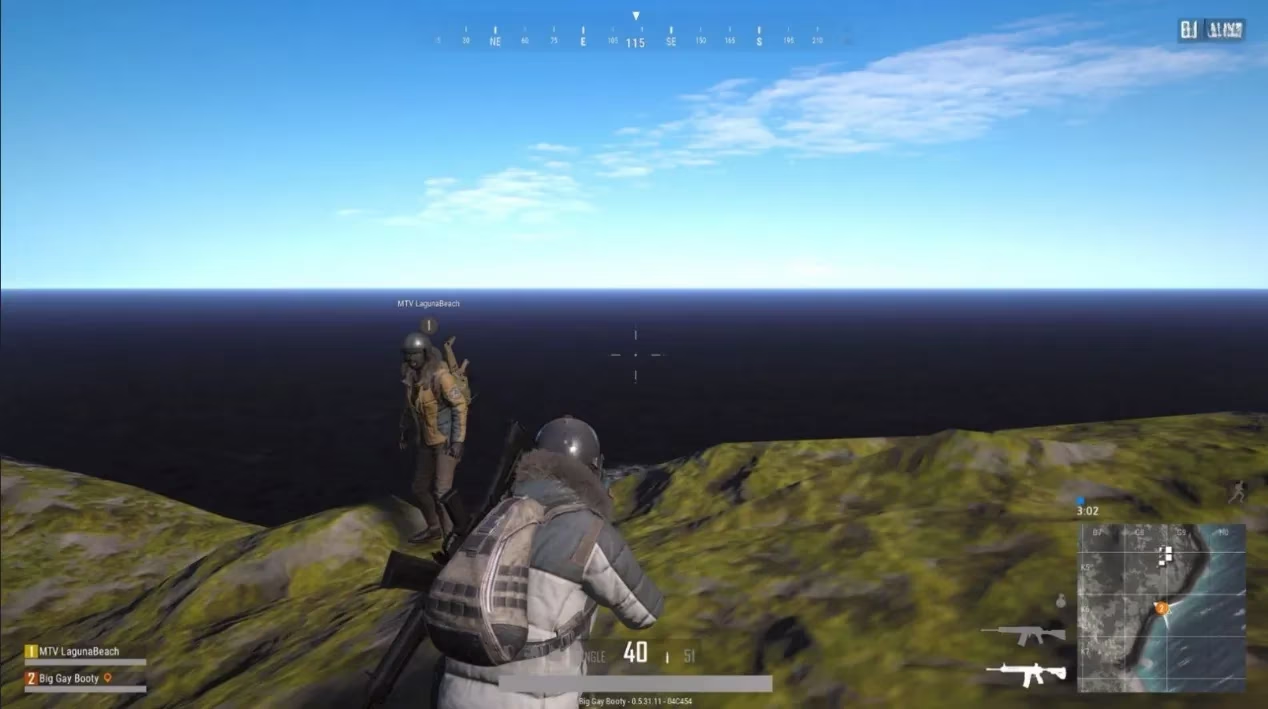
I remember the tale of @canceric, a story that feels both ancient and perpetually new. Earlier this decade, in the wild west of social media, they performed a digital sleight of hand. They took a screenshot—a single, frozen moment—from the chaotic, beautiful battleground of PlayerUnknown's Battlegrounds. The image was cropped with intent, showing only a vast, empty ocean meeting the sky in a line so perfectly, deceptively flat. This pixelated vista was then offered as proof, a sacred text, to a private Facebook congregation devoted to the belief in a flat Earth. The caption was a simple, provocative question: "Where is the curve?"
The reaction was a symphony of human credulity and conflict. Some in the group lauded it as definitive evidence, a 'gotcha' moment against the round-earthers. Others sensed the artifice, arguing about fisheye lenses and perspective. The beautiful irony, the punchline to the universe's joke, was revealed in the uncropped image: the full UI of the game, complete with blocky player characters standing on a cliff's edge, overlooking a world that never existed. @canceric was eventually banished from the group—a digital exile for a digital deception. For me, this wasn't just a prank; it was a poignant metaphor. In our search for truth, we so often clutch at the most convenient pixels, mistaking the map for the territory. Talk about a reality check!
A "Human Error" in the Theater of War
If the first act was comedy, the second was something darker, layered with the gravity of global conflict. Earlier that same week, a Russian state news network, in a report covering the grim reality of the Syrian War, aired footage they believed to be real. The tanks, the soldiers, the arid landscape—it was all so convincing. Except it wasn't. It was Arma 3, a meticulously crafted military simulator. The explanation was a brief, bureaucratic shrug: a "human error."
This moment has stayed with me. It underscores a profound shift in our era:
-
The Authenticity Crisis: When simulation achieves such fidelity, where does the benchmark for reality lie?
-
The Propaganda Potential: If it can be mistaken once, it can be used deliberately. A chilling thought.
-
The Emotional Cost: For a viewer, the horror of war is mediated through a screen; when that screen shows a game, what happens to our capacity for empathy?
This was no simple mistake. It was a crack in the foundation of trust we place in the images that inform our world.
A History of Graphical Ghosts
As I reflect, I see these are not isolated incidents but points on a continuum. They are ghosts in the machine, reminding us of our own suggestibility. For instance:
| Year | Game Used | Context of Mistake | The Resulting Vibe |
|---|---|---|---|
| 2016 | Fallout 4 | CNN report on Russian election hacking | A surreal blend of post-apocalyptic fiction and political anxiety 🤯 |
| 2018 | PlayerUnknown's Battlegrounds | Flat Earth 'evidence' on Facebook | Absurdist comedy meets internet conspiracy culture 😅 |
| 2018 | Arma 3 | Russian news report on Syria | Unsettling erosion of journalistic and geopolitical reality 😟 |
This table isn't just a list of errors; it's a map of our vulnerabilities. Each entry represents a moment where the willing suspension of disbelief, that contract we enter with art, was broken—not by the artist, but by the context.
The World in 2026: A More Deceptive Canvas?
Now, in 2026, the potential for such confusion hasn't diminished; it has exploded. We live in an age of:
-
Hyper-Realistic Graphics: Games are photorealistic. The uncanny valley is not just crossed; it's been paved over and turned into a suburb.
-
Generative AI and Deepfakes: Creating convincing fake footage from scratch is no longer the domain of high-end VFX studios. It's democratized, and oh so dangerous.
-
The Metaverse & AR Overlays: Where does the physical world end and the digital layer begin? The question is increasingly moot.
In this environment, the lesson from @canceric's post is more vital than ever: don't take anything at face-value on the internet. It's not just cynicism; it's a necessary survival skill for the digital soul. The controversy about games and violence simmers on, a predictable cycle, but beneath it flows this deeper, more intriguing current—the question of how we know anything we see is real.
My Personal Reflection: Living in the Simulation
So, what does this mean for me, a player, a viewer, a citizen of this interconnected world? I find a strange poetry in it. We build these incredible, immersive worlds to escape our own, only to have them leak back into our reality, challenging its very authority. It's a loop that speaks to the power of human creation. Every time a game is mistaken for real life, it's a backhanded compliment to the artists and programmers—a testament to their skill in crafting believable lies.
Yet, it's also a warning. As the tech gets better, the stakes get higher. The next "human error" might not be in a news report about a distant war, but in a piece of media that shapes public opinion on something happening right outside our doors. We've got to stay sharp, folks.
In the end, these blunders are more than funny or frightening anecdotes. They are signposts on our collective journey, marking the points where our fictional worlds and our factual one collide. They remind us that seeing is no longer believing. Believing requires questioning, context, and a critical eye that can tell the difference between a rendered ocean and a real one, between a game of war and the tragedy of the real thing. The horizon may look flat, but the truth, as always, is full of curves.
Comments